



Why do Procore and Autodesk Construction Cloud customers still have a safety data gap?
Procore ended 2025 with 17,850 customers and three million projects on its platform, while Autodesk Construction Cloud anchors the daily workflow of thousands more general contractors. These platforms run modern construction, but neither was built to verify what actually happens on site. Most GCs report high completion rates on their safety routines. Even so, the daily log cannot prove who walked through the gate or who signed the pre-task plan. That space between recorded activity and verified activity is the safety data gap BiltOn closes through Predictive Safety Management, turning verified field data into safety intelligence.
Safety data gap: the distance between the safety activity a project management platform records and the activity verified on site.
Verified field data: attendance, credentials, and safety routines tied to a confirmed worker identity, captured at the point of work.
What is the safety data gap in construction?
The safety data gap is the difference between the safety activity a project management platform records and the activity verified on site. A daily log shows who signed in and which forms were completed. It cannot confirm who entered the gate or whether routines were completed by the workers named on them.
Procore and Autodesk Construction Cloud are systems of record, built to store documents, schedules, and daily logs. They hold the information a person entered. They do not confirm what happened at the gate. A daily log can state that twelve workers from a subcontractor were on site, but it cannot show which twelve, how long they were there, or prove they completed the morning pre-task plan.
On a normal day, the gap shows up in small, familiar ways:
- Daily logs rebuilt from memory after the crews leave
- Headcounts keyed in by hand and rounded to an estimate
- Pre-task plans and toolbox talks self-reported on paper
- Inspection prep that means digging through folders for proof
Research from FMI and PlanGrid found that poor data and miscommunication drive 48% of US construction rework. The safety data gap is the safety-specific version of that problem. It is the reason completed routines do not always produce trustworthy construction leading indicators. The gap stays out of sight until an inspector or an insurer asks for proof.
Why Procore and Autodesk Construction Cloud leave a safety data gap on their own
Procore and Autodesk Construction Cloud leave a safety data gap because they were built for the office. They were designed for documents, cost, schedule, and collaboration. Neither one captures worker-level attendance or verifies that a routine was completed by the person named on it.
This is not a failure of either product, because both platforms do exactly what they were designed to do. The reality is a safety manager runs the morning huddle against the clock, then rebuilds the day’s record hours later from memory. The gap opens at the handoff from field to office and for years legacy tools picked up the slack.
| Safety workflow | Recorded in Procore / ACC today | What is missing | Why it matters to the field |
|---|---|---|---|
| Site attendance | Manual headcount in the daily log | A verified, worker-level entry record | Inspections and claims need who, not how many |
| Worker credentials | Document uploads | A live check that credentials are valid at entry | Expired certifications slip through |
| Pre-shift and pre-task plans | Self-reported or attached as a PDF | A link between the signature and a verified worker | Paperwork that looks complete but will not hold up |
| Subcontractor compliance | Vendor list plus COI files | A real-time tie to who actually worked | Uneven sub participation goes unnoticed |
| The 6pm reconstruction. The crews have gone home for the day. A safety manager sits with a clipboard, rebuilding the manpower count so the daily log will close. Years later, when a claim is filed, that count is the only record of who was on site. |
Pre-task plans carry the same weakness, because a plan signed on paper for a crew that never read it looks the same as one that did its job. Our guide to pre-task plan best practices covers the fix. The gap is structural, and BiltOn was built to supply the missing layer of Safety Intelligence.
How BiltOn closes the safety data gap alongside Procore and Autodesk
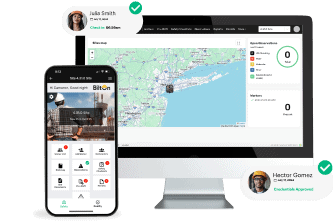
BiltOn closes the safety data gap by capturing verified data where it is created, at the gate and in the field. Access control and 3D facial verification confirm who is on site. Pre-shift, toolbox, and pre-task plan routines log against verified worker profiles. Two-way sync then pushes all of it into Procore and Autodesk Construction Cloud automatically.
BiltOn is the safety intelligence platform that delivers better risk, recommends action, and is the foundation of Predictive Safety Management. It is the verifiable truth layer that makes a project management system of record accurate, using the same connected approach that safety directors use to run intelligent workflows.
For a safety manager, the daily routine changes in practical ways:
- The headcount is captured automatically, instead of rebuilt from a clipboard.
- Subcontractor safety documentation is captured the moment crews badge in.
- The morning huddle moves faster, because pre-shift sign-in happens on the worker’s phone.
- Routines run in the language the crew reads, which supports multilingual safety compliance.
The integration itself runs as a short, repeatable sequence:
- A worker is verified at site entry through access control or 3D facial recognition.
- Attendance and headcount post to the daily log automatically.
- Pre-shift, toolbox, and pre-task plan routines log against that verified worker profile.
- BiltOn syncs the data into Procore or Autodesk Construction Cloud every 15 minutes.
- The platform of record reflects verified ground truth instead of a manual estimate.
Now, when an OSHA inspector or carrier asks what really happened on a given day, the record matches the safety manager’s memory instead of exposing gaps.
Setup takes about five minutes and needs no technical skill. Every routine becomes structured jobsite safety documentation, with construction PTP documentation tied to each verified worker. The office keeps its system of record while BiltOn makes it accurate at the worker level.
| Data | Direction | Procore | Autodesk Construction Cloud |
|---|---|---|---|
| Verified attendance and headcount | BiltOn to platform | Yes | Yes |
| Vendor and company list | Platform to BiltOn | Yes | Yes |
| Pre-shift records | BiltOn to platform | Yes | Yes |
| Safety routines (PTP, toolbox, JHA) | BiltOn to platform | Yes | Yes |
| COIs, permits, contractor documents | BiltOn to platform | Yes | Yes |
| Sync frequency | Both directions | Every 15 minutes | Every 15 minutes |
What closing the safety data gap looks like on real jobsites
Three BiltOn customers show what a closed gap delivers: accurate logs, defensible records when a claim surfaces, and one source of truth across field and office.
Hunter Roberts Construction Group adopted BiltOn at the start of a major New York build. The team runs daily logs, certifications, and orientations through the platform, and the data flows into Autodesk Construction Cloud. In a recent webinar, Corey Jones, VP of Corporate Safety, put it plainly: “When you consider the cost of an incident, the recovery is astronomical. That’s why having the right tools and processes in place isn’t optional. The ROI speaks for itself.”
Vorea started with access control and expanded into compliance and safety workflows. The team linked real-time worker logs into Procore for site-wide analysis. Pat Feehan, VP of Construction, describes a before state most will recognize: “Before BiltOn, it was all daily reports and headcounts by hand. You hoped the numbers matched reality. But deep down, you knew they didn’t.”
| Customer proof point: Archstone Builders. Archstone replaced badge swiping with 3D facial recognition and connected BiltOn to Procore. When two workers filed a workers’ compensation claim for an injury on a Bronx site, the verified attendance logs disproved it, because the records showed neither worker had been on site that day. Across BiltOn’s customer base, verified identity prevents an average of three fraudulent claims per project. |
For Safety Managers and EHS leaders, these stories mean fewer late-night calls, fewer disputed logs, and less scrambling before inspections. For Safety Directors, they mean one defensible standard across jobs instead of a patchwork of site practices. For executives, they translate into fewer surprise losses and a clearer story to tell at renewal.
How closing the safety data gap supports EMR and insurance outcomes
A closed safety data gap is more than a reporting upgrade. It is a risk-reduction lever leadership can fund. Verified field data becomes Safety Intelligence, and it delivers enterprise visibility, standardization across the portfolio, audit readiness, and stronger underwriting confidence at renewal.
For an executive team, the safety data gap is an operating-risk problem in disguise. Unverifiable records raise financial exposure on every open claim. Construction recorded 1,032 worker fatalities in 2024, and a single medically consulted injury averages $48,000, according to the BLS and the National Safety Council. Those costs land on the same balance sheet leadership works to protect.
Closing the gap converts that exposure into a stronger renewal position. Identity-tied attendance, pre-task plans, and observations form safety audit trail documentation that holds up across the multi-year claim window. EMR is calculated on a rolling three-year window, so today’s discipline shows up in renewal terms 18 to 36 months later.
For leadership, closing the safety data gap is a funded lever: a relatively small platform investment that reduces total cost of risk, improves renewal terms, and protects project margins.
| A closed gap delivers | Business outcome | BiltOn proof point |
|---|---|---|
| Verified attendance | Claims defensibility, less fraud exposure | 3 average fraudulent claims prevented per project |
| Credible leading indicators | Fewer incidents, decision-grade data | 30% reduction in incident rates |
| Faster routine completion | Less admin drag, scalable controls | 15 to 20 hours per week of admin saved |
| Standardized safety record | Underwriting confidence | 30% average reduction in EMR |
For an executive team, this turns safety from a compliance cost center into a measurable driver of margin, predictability, and carrier confidence.
Across BiltOn’s customer base, Predictive Safety Management delivers up to $955,000 saved per project and a 30% average reduction in EMR. Premium impact depends on the insurer and project profile, but the direction is consistent. Carriers price the risk they can see, which is a large part of why carriers are repricing GCs.
Conclusion
Procore and Autodesk Construction Cloud tell you the project is moving. They were not built to tell you the field is safe and verified. BiltOn adds the Safety Intelligence layer inside the platform you already run, with no rip-and-replace.
For Safety Managers and EHS leaders, that means faster mornings, cleaner documentation, and fewer gaps to explain when someone asks what really happened on site. For Safety Directors, it means standardized, worker-level data across every project instead of a patchwork of daily reports. For executives, it means lower total cost of risk, stronger renewal positions, and fewer surprises buried in claims.
Request a demo to see how the integration works. and what closing the safety data gap would look like across your jobs.
Frequently Asked Questions
-
What is the safety data gap in construction?
The safety data gap is the difference between what a project management platform records and what was verified on site. A daily log shows what someone entered. It does not confirm who entered the gate or whether routines were completed by identified workers.
For a Safety Manager or EHS Manager, this gap shows up every day as:
- A daily log that looks complete but can’t prove who was actually on site
- Paper or PDF signatures with no way to show the right worker planned the task
- Subcontractors who appear compliant on paper but don’t consistently participate in routines on site
-
Does BiltOn replace Procore or Autodesk Construction Cloud?
No, BiltOn does not replace either platform. It integrates with both through two-way sync, so your team keeps Procore or Autodesk Construction Cloud as the system of record while BiltOn feeds verified field data into it.
-
What data syncs between BiltOn and Procore or Autodesk Construction Cloud?
BiltOn syncs verified attendance and headcount, daily logs, pre-shift records, and safety routines such as pre-task plans and toolbox talks. Vendor and company lists sync the other way, keeping subcontractor records aligned.
-
Is BiltOn attendance data accurate enough for inspections and audits?
Yes, because attendance is verified at the worker level through access control and 3D facial verification. That gives inspectors and insurers a time-stamped record of who was on site.
References
BiltOn. (2026). How Safety Directors Use Intelligent Workflows to Improve the Compliance-to-Conformance Gap.
BiltOn. (2026). Why Carriers Are Repricing GCs.
BiltOn. (2026). Why Lagging Indicators Are Not a Safety Strategy.
BiltOn. (2026). Why Pre-Task Plans Fail on Jobsites.
Bureau of Labor Statistics. (2025). Census of Fatal Occupational Injuries, 2024.
FMI Corporation & PlanGrid. (2018). Construction Disconnected: Rethinking the Management of Project Data and Mobile Collaboration.
National Safety Council. (2024). Work Injury Costs.
Procore Technologies. (2026). Fourth Quarter and Full Year 2025 Financial Results.