
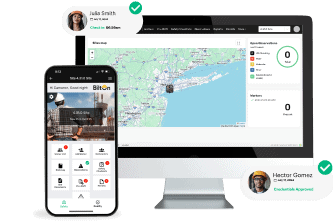



“If your safety guy is stuck onboarding instead of walking the site, that’s a gap in your coverage. The system doesn’t just save money, it clears the way for people to do their actual jobs.”
Lettire Construction Director of Preconstruction & Operations Greg Stewart frames the operational stakes of the morning routine bluntly. Lettire’s switch to QR self-onboarding cut a 30-worker concrete crew’s onboarding from two hours to minutes, and the rest of the operating model followed. The pre-task plan is the highest-leverage moment in all of jobsite safety documentation, because it is the only routine where the right person plans the right work in language they understand, before anyone gets hurt.
It is also the most-failed documentation moment on the jobsite, where Predictive Safety Management either runs or breaks, and where a generation of field discipline either becomes Safety Intelligence or stays paper. The trailer at 6:45 AM operates under conditions that are hostile to documentation: 40 workers, five trades, two degrees, and a five-minute window before the gate closes. Predictive Safety Management starts there, at the 40-signature moment, where the loop closes or the loop breaks for the rest of the day.
Predictive Safety Management: the operating discipline of converting daily field routines (PTPs, toolbox talks, observations, credentialing) into preventative risk signals before incidents occur. It is the operating model Safety Managers use to move from paperwork chasing to proactive risk reduction.
Safety Intelligence: the data set Predictive Safety Management produces. It is verified, decision-ready safety audit trail documentation that supports daily safety decisions, holds up under inspection, and turns risk mitigation from reactive to proactive.
The Most-Failed Documentation Moment on the Jobsite: the trailer at 6:45 AM, where 40 workers, five subcontractors, and four languages compete with a five-minute window before the gate opens. It is the field-level routine the entire safety operating model depends on.
What makes the pre-task plan the highest-leverage signal in the safety stack?
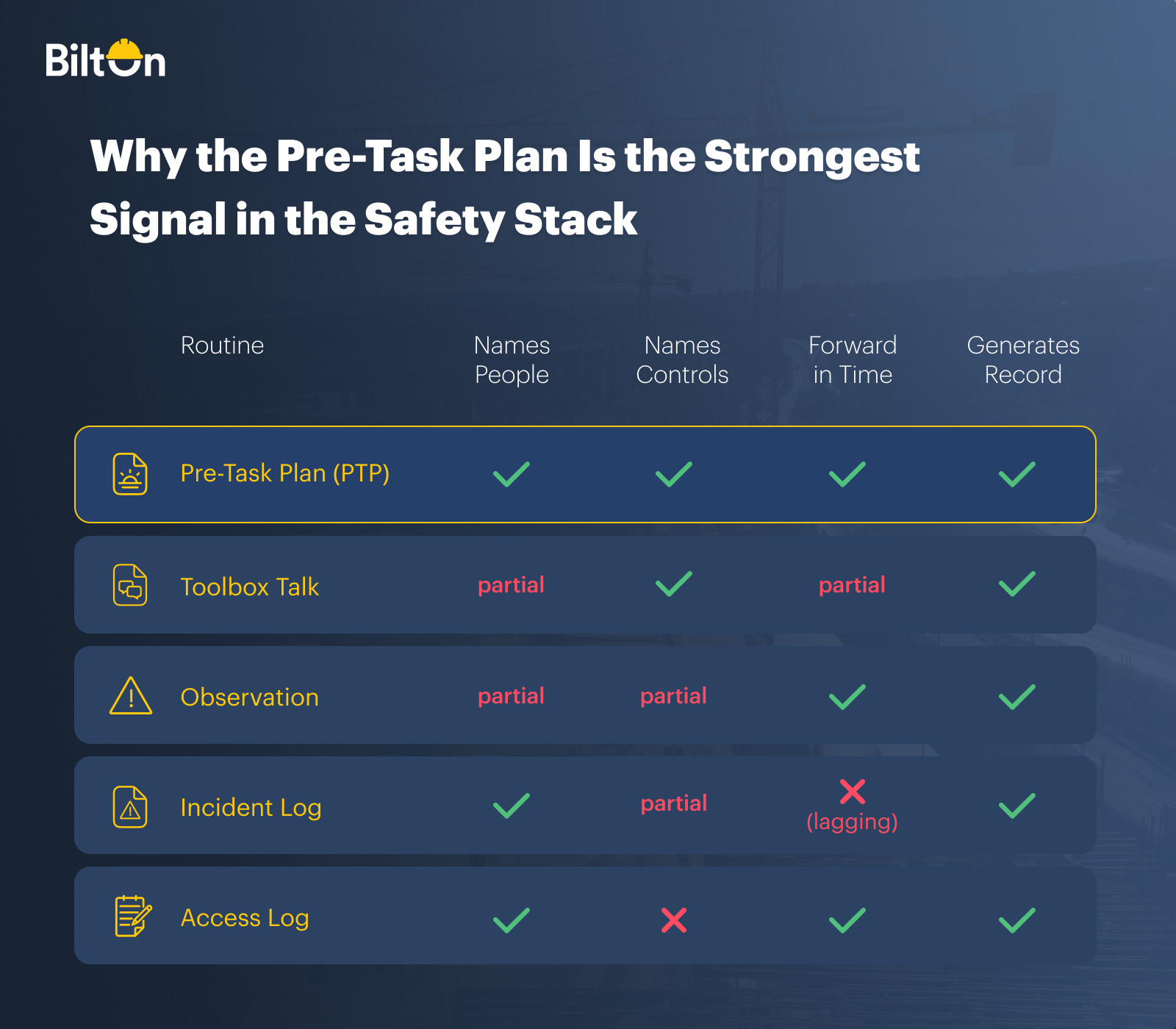
The PTP is the only routine that combines four things at once; it names the people on the work, names the controls for the day, pulls the signal forward in time before the work starts, and generates a record. Nothing else on the jobsite does all four successfully. Toolbox talks happen weekly, observations happen reactively, and incident logs happen after the fact. Meanwhile, access logs only confirm someone was on the site and not that they were planned for the work they actually did. Pre-task plan best practices treat PTP as the anchor of the daily safety routine, not a form to clear before the gate opens.
| Routine | Names People | Names Controls | Forward in Time | Generates Record |
|---|---|---|---|---|
| Pre-Task Plan (PTP) | ✓ | ✓ | ✓ | ✓ |
| Toolbox Talk | partial | ✓ | partial | ✓ |
| Observation | partial | partial | ✗ | ✓ |
| Incident Log | ✓ | partial | ✗ (lagging) | ✓ |
| Access Log | ✓ | ✗ | ✓ | ✓ |
OSHA explicitly identifies pre-task planning as a leading indicator of safety performance for construction trade partners, and the agency does not flag leading indicators lightly. Construction leading indicators are the metrics that move incident probability before the incident lands, and the PTP is the daily one Safety Managers actually own. Dodge’s SmartMarket Report on Safety Management in the Construction Industry is the cleanest view of why this matters: 73% of contractors who create comprehensive health-and-safety plans before construction starts experience reduced recordable injury rates, and 74% report increased worker engagement with safety processes. The PTP is the daily, granular version of that broader plan. It is the routine that translates strategy into preventative risk on the ground.
That is the upside. The downside is that the PTP is also where most of the data set fails. The dashboards in the office, the audit pack a third-party inspector expects on five minutes’ notice, the safety audit trail documentation a three-year-old claim file needs, all of it depends on what happens in those ten minutes between when the crew shows up and when the work starts. The operating reality of incomplete daily documentation lives in the trailer, with the Safety Manager who has to make the routine actually run in conditions that fight back.
The financial framing is in the C-suite piece in this series, The Leading Indicator Premium: Why Carriers Are Repricing GCs That Can’t Show Behavioral Data, but the operating reality lives in the trailer.
Defining the 40-signature problem
The 40-signature problem is the open secret of construction safety. A foreman walks into the trailer at 6:45 AM. Forty workers across five subcontractors are waiting to start. The PTP form is in English. The crew speaks Spanish, Polish, Mandarin, and English. The form is supposed to document a planning conversation with each individual worker about the day’s hazards and controls. The clock is the gate at 6:50.
What actually happens at 6:45 AM
| Pattern | What It Produces |
|---|---|
| One paper roster gets passed around and 40 workers initial it without reading what they signed | Compliance metric reads 100%; conformance reads zero |
| The foreman pre-fills today’s hazards based on yesterday’s PTP, which was based on the day before’s | A static document with no relationship to today’s actual work |
| Workers who do not read English initial a form they cannot read, in a language no one explained | A signature with no informed consent and no defensible meaning |
| The crew that arrived late signs at lunch, and the timestamp does not match when they actually started work | A record that fails the audit-trail test on first inspection |
| The subcontractor’s PTP gets photographed and sent to the GC’s safety inbox | Data that sits unprocessed until someone needs to find it for an audit |
The compliance metric reads 100% because forty workers signed the form and the dashboard turned green, but the conformance reality is closer to zero. No individualized planning conversation happened, in language the workers could understand, before the work started. OSHA’s training standards policy explicitly requires instruction in a language and vocabulary workers can understand, and foreign-born workers were 25.3% of the US construction workforce in the most recent BLS Spotlight on Statistics.
A safety stack that assumes English fluency, desktop access, or training time at the start of the day will produce paper construction PTP documentation at scale. The paper data will not survive the moment someone asks whether the worker who fell was actually planned for the work he was doing.
This is the failure that breaks programs, and laziness is not the cause. The morning routine, as designed, cannot survive the conditions it has to actually run in. Time pressure on morning huddles, inconsistent subcontractor participation, and language barriers are not edge cases — they are the default operating conditions. The form is asking workers to slow down at the exact moment the schedule is asking them to ramp up, quickly. The easy solution for those in the field ready to work is to sign everything in the two minutes before the day starts. The most failed documentation moment is born in that window every morning, on every jobsite running this routine.
What does the morning PTP routine have to look like to actually run in the field?
This is the part most safety stacks get wrong. Forms get designed in the office with the assumption that the field will adapt to them, and the field rarely does. A morning PTP routine that does not fit the conditions in the trailer will be skipped, shortcut, or signed in bulk, regardless of how clean it looks on a laptop in a conference room. The five pre-task plan best practices below define a routine that produces preventative risk signals instead of paper, without piling more admin burden on the Safety Manager already stretched thin across the jobsite.
1. The phone has to be the only tool
Workers carry a phone. They do not carry a laptop, a desktop, or a tablet stored at the supe’s trailer. If the routine requires a desktop login, a separate device, or anything that adds friction at the gate, it will be skipped. The platform has to work on the phone the worker already has, in landscape mode, with one thumb, in a glove, in cold weather, before coffee.
2. It has to work offline
Cellular dead zones are real in below-grade work, in steel-frame structures with thick concrete, and in remote sites. A morning routine that cannot capture the PTP without a connection is broken before it starts. Capture has to happen offline and sync when the connection returns, with the worker never knowing the difference.
3. The language has to be the worker’s
Spanish, Polish, Mandarin, and other languages have to be first-class capture experiences for multilingual safety compliance to be real, not translation overlays added to an English form. The hazard and control terms in the worker’s language are the terms that matter for conformance. If a Spanish-speaking laborer initials “fall protection” without a Spanish equivalent in the workflow, the document is not evidence of planning.
4. The signature has to be tied to the worker, not the form
This is the structural correction the 40-signature problem demands. One person, one signature, one PTP. Identity tied to every PTP is the difference between a paper artifact and a behavioral record. Voice-recorded huddles, individual mobile sign-in with verified credentials at the gate, and AI analysis of the audio for trade-specific control terms are all ways to do this without slowing the morning down. Voice-recorded PTPs in particular let the crew run a real planning conversation in five minutes, with the AI surfacing the conformance signal afterward. “Fall protection” was mentioned. “Hot work” was not. The foreman gets a quiet flag if the day’s high-risk activity was missed.
5. The whole thing has to be five minutes or less
The schedule does not care about the safety routine. The schedule cares about when the crew is on the work. A morning routine that takes 15 minutes will be defeated. A morning routine that takes five minutes will run. The ergonomics are the difference between a routine that captures conformance-grade data daily and a routine that captures compliance theater. For the Safety Manager, this is the difference between reducing admin burden without losing accountability and watching the field undermine the program one shortcut at a time.
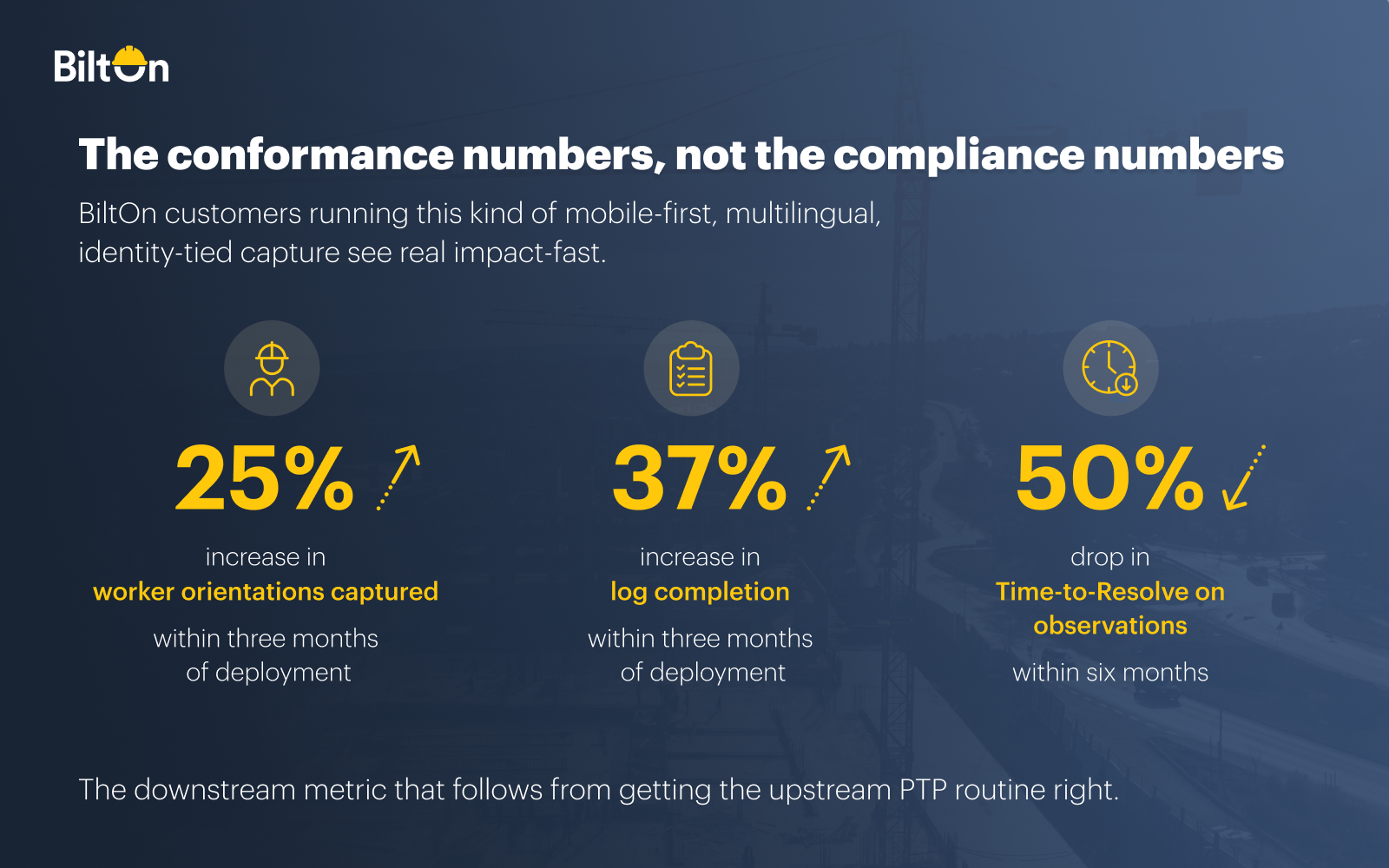
How this routine ladders up to portfolio-wide outcomes is covered in the companion piece, The Three Failure Modes of Safety Routine Data.
What does this look like on a real morning?
Picture the same trailer, with a routine that fits the field. The morning runs as a five-step intelligent workflow.
| Time | Step | What Happens |
|---|---|---|
| 6:30 AM | Pre-arrival checks | Credential expirations are flagged automatically. The supe gets an alert if a worker’s certification lapsed three weeks ago, and the gate closes for that worker before he ever scans in. |
| 6:42 AM | Foreman opens the platform | The day’s PTP template is already pre-loaded based on the schedule. Concrete patchback on floor 14, fall-protection requirements live, hot work permits already cleared for the welding crew. |
| 6:45 AM | Workers scan in at the gate | Each worker scans a badge or facial verification. Identity ties to the day’s PTP automatically. The platform tells them, in their language, what the day’s three highest hazards are. |
| 6:48 AM | The huddle | Five minutes, voice-recorded, with the foreman walking the crew through the controls. Audio captured. AI analyzes trade-specific control terms. |
| 6:53 AM | Conformance check | “Fall protection” was discussed. “Hot work” was not. Foreman gets a quiet flag, circles back for 90 seconds, fixes it, moves on. |
| 6:55 AM | Crew on the work | Identity-tied, time-stamped, voice-verified, individualized data set captured. Nothing about the morning slowed down. Everything about the data set just changed. |
The Most-Failed Documentation Moment becomes the highest-leverage one, in five minutes, every morning. That is what Predictive Safety Management looks like in practice: preventative risk surfaced before incidents, verified at the worker level, converted into safety audit trail documentation that holds up the first time anyone asks for it.
How does the morning routine ladder up to insurance, audit, and Predictive Safety Management?
OSHA inspectors do not look at one PTP. They look at three years of PTPs as a data set. OSHA’s maximum penalty for willful or repeat violations is $165,514 per violation in 2026, and the agency’s recordkeeping rules require GCs to produce documentation that holds up under audit. NYC DOB Buildings Bulletin 2024-007 formally permits digital record-keeping for required site safety logs, raising the bar for contractors still operating on paper. The OSHA compliance officer, the third-party safety auditor, and the internal claim review team three years after closeout all want the same thing: a continuous, time-stamped, identity-tied record of who planned what work, when, and how. Proving compliance during inspections stops being a scavenger hunt the moment that record exists by default.
BiltOn portfolio outcomes from this routine
| Outcome | Result |
|---|---|
| Worker orientations captured | +25% within 3 months |
| Log/checklist completion | +37% within 3 months |
| Time-to-Resolve on observations | 50% reduction within 6 months |
| Claims prevented per project | 3 (average) |
| Premium and deductible reduction per project | 7% |
| EMR score reduction year-over-year | up to 30% |
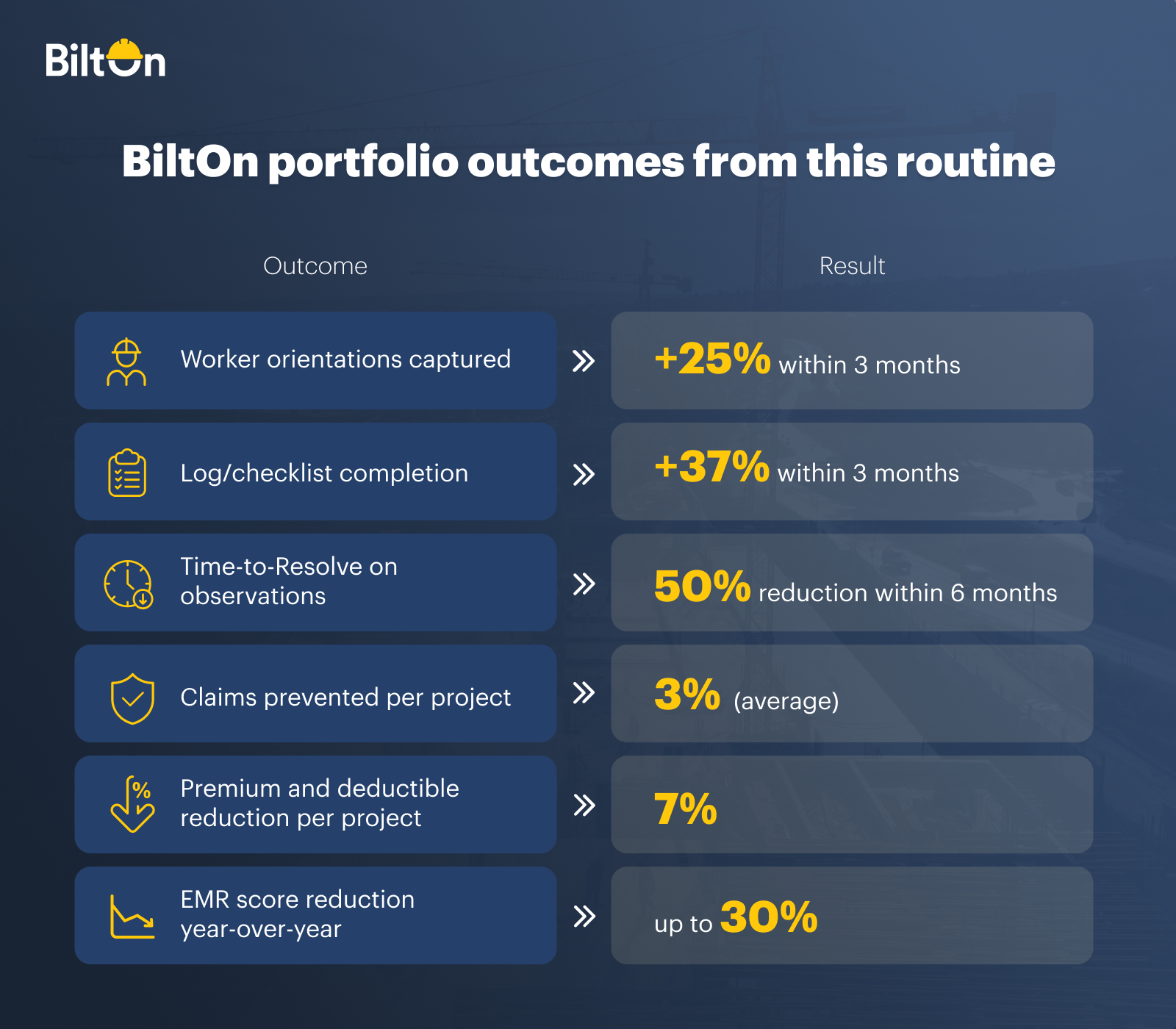
The morning routine produces these outcomes and a dashboard only summarizes them. When a baseless claim arrives two years after closeout, the safety team with verified digital records closes it in minutes while the team with binders spends weeks rebuilding the file and still ends up exposed.
The framing of why incident counts alone cannot do this work is in our prior piece, Lagging vs Leading Indicators of Safety Risk. This is the connective tissue of Predictive Safety Management: preventative risk identified at the trailer, risk mitigation executed in five minutes, better leading-indicator data flowing into your dashboards day over day, month over month.
Conclusion
The morning routine is the unglamorous core of the entire safety operating model. It is where safety strategy meets crew reality, and it is where every dashboard upstream either holds or falls apart. The need to hastily sign 40 signatures 5 minutes before the gates open is the obstacle, one that can be solved with a routine that actually fits how we work today. The solution is phone-only workflows which have offline capabilities, multilingual support, are tied to identity, and can be completed in five minutes or less.
Predictive Safety Management is the lens that connects what happens in those five minutes to what shows up in your inspection reports, audit trails, and leading-indicator dashboards for years after the project closes.
When the work in the trailer is good, the data set is good. When the data set is good, the carrier can underwrite it, the OSHA inspector can read it, and the team in the office can use it. None of that runs without the crew running it, and the crew will only run it if the routine fits the conditions of the morning. Get that right, and the rest of the operating model will follow.
Want to see what a 5-minute, identity-tied, voice-PTP morning routine looks like?
Request a demo.
Frequently Asked Questions
1. We have a PTP form. Why does the format matter so much?
The format determines whether a planning conversation actually happens. A roster-style form invites bulk signing. An individualized, identity-tied form forces the planning to happen worker-by-worker. The same content in a different format produces different conformance, even with the same crew. Format is the difference between compliance theater and pre-task plan best practices that actually move the leading indicator.
2. Our crews speak multiple languages. How do we handle that without slowing down the morning?
First-class multilingual safety compliance means every worker sees the form in their language by default, not a translation overlay added after the fact. Voice-recorded huddles let the foreman run the conversation in the language the crew speaks, with AI surfacing the trade-specific control terms afterward. The morning runs at the same speed; the data set changes from paper to behavioral evidence.
3. What about subcontractors? They have their own systems and forms.
This is the structural challenge of multi-tier subcontracting, and inconsistent subcontractor participation is one of the most-cited frustrations Safety Managers raise about the morning routine. The pattern that works is to make the GC’s mobile capture the standard at the gate, with subs joining through the same workflow rather than running parallel paper. Identity verification at site entry means the sub’s worker is tied to the GC’s PTP for the day, regardless of which company employs them. That is what produces clean subcontractor safety documentation across crew turnover and supports preventative risk decisions across the portfolio.
4. What is the simplest first move if our morning routine is broken right now?
Move the PTP off paper and off roster sheets, in that order. Individualized digital sign-in tied to verified worker identity is the single change that produces the biggest data quality improvement, and it is achievable without changing anything else in the operating model. Once that is running, the multilingual layer, voice-PTP analysis, and gate-level credential verification stack on top.
5. How does the Most-Failed Documentation Moment fit into Predictive Safety Management?
Predictive Safety Management is the operating discipline of converting daily field routines into preventative risk signals before incidents occur. The PTP is the daily routine that anchors the discipline, and the trailer at 6:45 AM is where it either succeeds or fails. Fixing the Most-Failed Documentation Moment is the upstream prerequisite for everything downstream: leading-indicator dashboards, claim defense, EMR reduction, and the audit-ready Safety Intelligence that holds up under inspection.
References
- Bilton. (2026). The Leading Indicator Premium: Why Carriers Are Repricing GCs That Can’t Show Behavioral Data.
- Bilton. (2026). The Three Failure Modes of Safety Routine Data: How Top GCs Are Closing the Loop From PTP to Premium.
- Bilton. (2026). Lagging vs Leading Indicators of Safety Risk: Why Incident Counts Alone Fail Construction Leaders.
- Bureau of Labor Statistics. (2022). The Construction Industry: Characteristics of the Employed, 2003–20 [Spotlight on Statistics].
- Dodge Construction Network & CPWR. (2023). SmartMarket Report: Safety Management in the Construction Industry.
- New York City Department of Buildings. (2024). Buildings Bulletin 2024-007: Digital Record-Keeping for Required Site Safety Logs.
- Occupational Safety and Health Administration. (n.d.). OSHA Penalties.
- Occupational Safety and Health Administration. (n.d.). Leading Indicators in Construction Safety.
- Occupational Safety and Health Administration. (2010). Standard Interpretation: Multi-employer language and accident statistics.
- Zurich North America. (2025, November 14). Zurich Selects Arrowsight to Help Transform Construction Site Safety [Press Release].