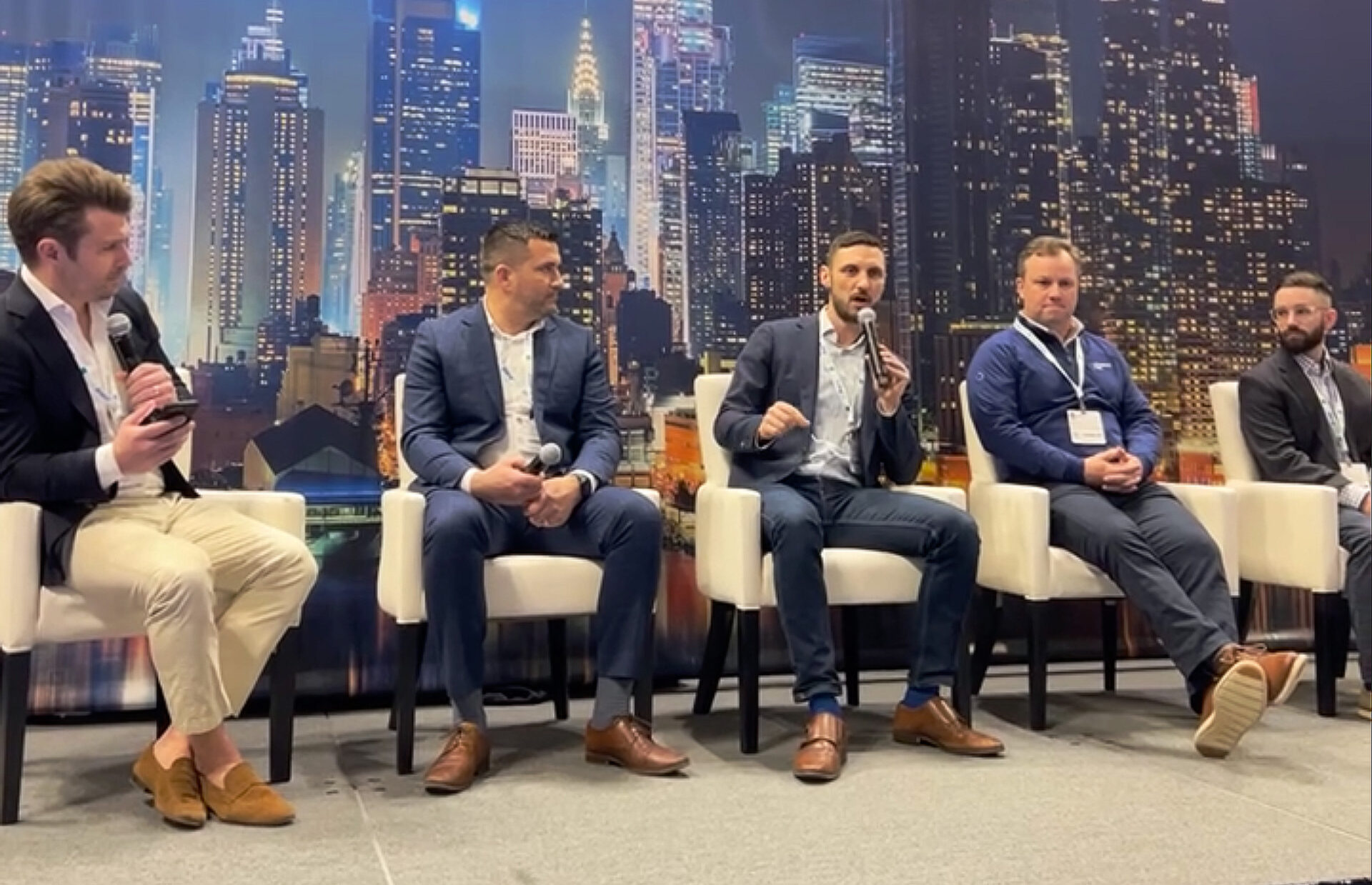
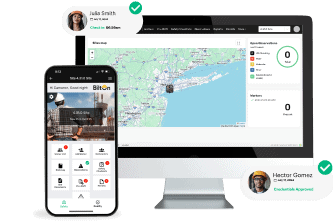



Why does “100% PTP completion” still produce uninsurable data, and how do intelligent workflows fix it?
Safety directors may see this daily: crews signed in, forms completed, dashboards green — but the data still does not prove that the right conversation or corrective action took place at the right time. No closed-loop. No plan in place for future risk.
Most enterprise General Contractors report high completion rates on the safety routines that matter, yet 1,075 construction workers died on US jobsites in 2023, accounting for 23.71% of all worker fatalities that year (BLS), and the data those routines produce often will not survive an underwriter, an OSHA inspection, or a fraudulent claim filed three years after closeout. In a recent webinar, Hunter Roberts VP of Corporate Safety Corey Jones puts it bluntly: “When you consider the cost of an incident, the recovery is astronomical. That’s why having the right tools and processes in place isn’t optional, the ROI speaks for itself.” The gap between green dashboards and red realities is structural. Most safety stacks generate compliance data; few generate safety intelligence.
Closing that gap requires dynamic, automated, and interconnected workflows, the operating model at the heart of Intelligent Safety Management, and the foundation top GCs are using to convert behavioral data into compressed premium and lower EMR.
Safety Intelligence: verified field data you can use to spot risk, defend claims, and support renewal conversations.
Intelligent workflows connected safety routines — like PTPs, observations, credentialing, and incident reporting — that create that data without adding field admin.
What is the compliance-to-conformance gap, and why does it matter?
Compliance is whether the form was completed. Conformance is whether the planning conversation actually happened, in the language the crew speaks, before the work started. Industry research has been pointing at this gap for years.
The Dodge / CPWR SmartMarket Report on Safety Management in the Construction Industry documents that large firms run PTPs daily at high rates, but a sizable accessibility gap persists in how easily workers can read and engage with PTP content on site. OSHA explicitly identifies pre-task planning as a leading indicator of safety performance for construction trade partners, but the agency does not write the standard for what “completed” means in practice. The GC does.
The financial framing for this gap is in our companion piece, Why Carriers Are Repricing GCs That Can’t Show Behavioral Data, which lays out why carriers have begun pricing the absence of clean behavioral data directly into renewal premiums. The director’s challenge is the operational version of the same problem: producing the data set that lets the C-suite tell the story to the underwriter.
The cost of getting it wrong compounds. FMI and PlanGrid’s Construction Disconnected research found that,
- 35% of project team time is spent on non-productive activities (looking for information, dealing with conflicts, fixing rework).
- 48% of US construction rework is caused by poor data and miscommunication, costing the industry an estimated $177 billion per year.
The compliance-to-conformance gap is the safety-specific version of that broader data problem, and it is the operating problem intelligent workflows are designed to solve.
For a safety director, this gap is where paperwork stops being protection.
The Three Failure Modes That Block Safety Intelligence
Three failure modes drive most of the leakage between routine completion and renewal-grade data. Each is fixable. Each is the difference between a compliance artifact and an intelligent workflow. If you manage safety across multiple jobsites, these are the three places your data usually breaks down:
| Failure Mode | What It Looks Like | What Intelligent Workflows Fix |
|---|---|---|
| 1. Collection Without Conformance | Forms get signed; the planning conversation never happened | Identity-tied, multilingual, individually-signed PTPs with quality signals |
| 2. Disconnection Across Routines | Each routine lives in its own app, with its own identity model | One verified worker identity tied to every event; two-way Procore + Autodesk sync |
| 3. Data Without Action | Risk clusters are visible; no corrective action is assigned in time | Severity-tiered auto-routing, TTR reported at the project-executive level |
Failure Mode 1: Collection Without Conformance
This is the most common failure, and the one safety directors are most often unable to see from the dashboard. Collection without conformance happens when a form gets signed but the planning conversation it is supposed to document never actually happens, at least not in a way the worker can repeat back.
In practice, this looks like:
- A foreman signs a paper PTP roster 40 times at 6:45 AM because the gate opens at 6:50.
- Digital sign-in is high, but engagement checks show only roughly half of sampled workers can restate the key control from the last three toolbox talks.
- Spanish-, Polish-, or Mandarin-speaking crews initial English-language forms they cannot read.
- Subcontractor PTPs come in as photographs of identical templates filled out by a single signer for a 12-person crew.
The cost is silent until it is loud. When a recordable lands and the carrier or plaintiff’s counsel asks for the PTP that covered the activity, the GC produces a stack of forms, but those forms cannot demonstrate the worker was actually planned for the work. OSHA estimates language barriers contribute to roughly 25% of job-related accidents, and foreign-born workers made up 25.3% of the US construction workforce in the most recent BLS Spotlight on Statistics. Any safety stack that assumes English fluency, desktop access, or a training budget will produce paper data at scale.
The smart workflow that Safety leaders should review weekly:
- Are PTPs individually signed or roster-signed?
- Can workers access forms in their primary language?
- Do you have any quality signal beyond completion rate?
- Can sampled workers restate the top control?
Failure Mode 2: Disconnection Across Routines
The second failure mode is structural and unique to enterprise GCs running multiple platforms. Each safety routine (orientation, access, PTP, inspection, observation, incident, training) runs in its own app, against its own data model, with its own set of identities. The routines exist; the intelligent workflow does not.
The identity reconciliation problem
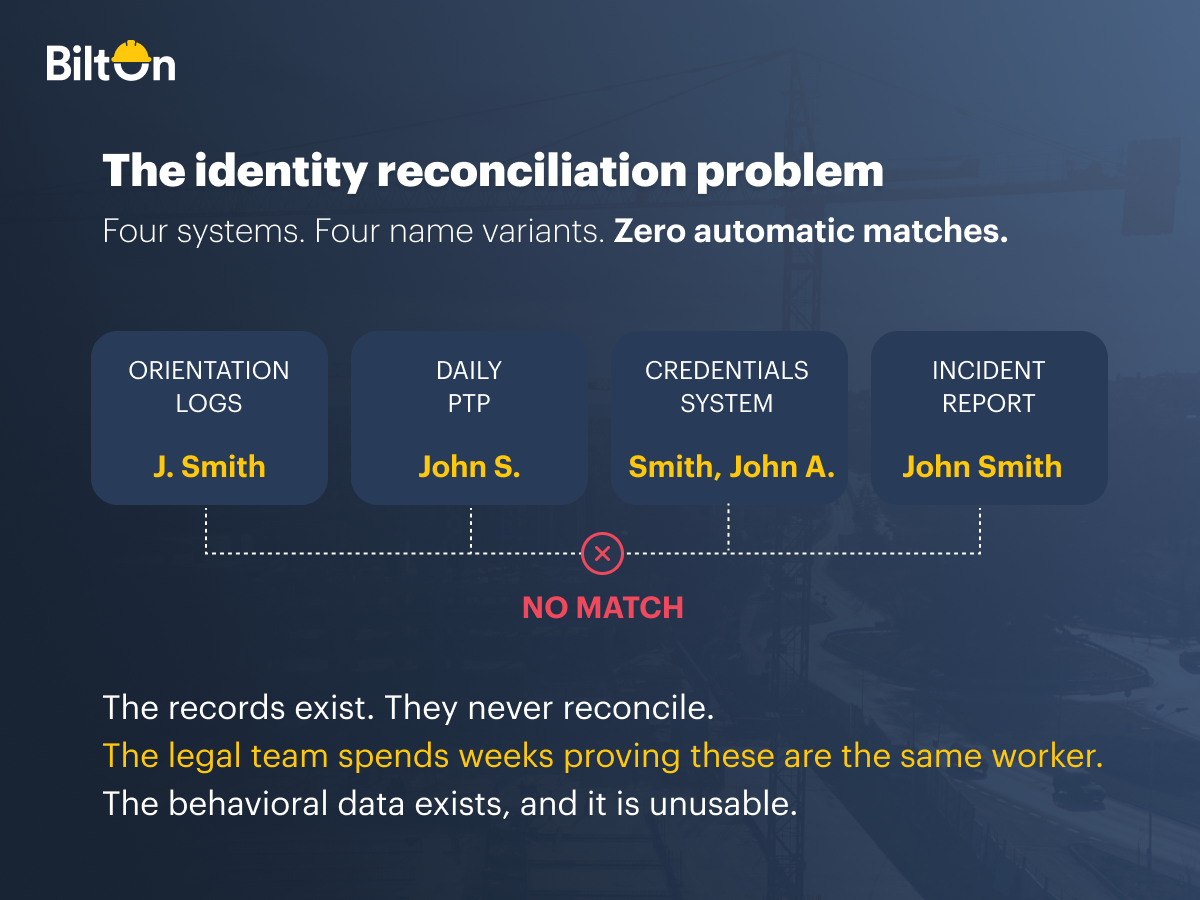
This is what broken safety data looks like in the real world: the records exist, but they do not hold together when someone actually needs them.
The downstream cost is governance loss. Most enterprise GCs are running 15 to 20 systems across safety, operations, finance, and compliance, and a foreman asked to use ten different apps in a single shift will use zero. Industry surveys consistently report that roughly a third of contractors say more than half of their project data is unreliable, tracing directly back to systems that were never designed to talk to each other.
Three things intelligent workflows do to close this gap
-
One verified worker identity tied to every event (orientation, access, PTP, observation, incident) across the lifecycle of every project.
a. Why it matters: makes claims, audits, and incident reviews defensible.
-
Two-way integrations with Procore and Autodesk Construction Cloud.
a. Why it matters: reduces double entry and keeps safety data aligned with project data.
-
Worker-to-supervisor ratio alerts that trigger when headcount changes outpace orientation capacity, with field-vs-office reconciliation tracked as its own leading indicator.
a. Why it matters: surfaces risk before field capacity falls behind headcount.
Customer proof point: Archstone Builders
When worker identity is fragmented across systems, claims become harder to defend. When identity is unified, false claims are easier to disprove.
Archstone Builders used integrated identity records to disprove a fraudulent workers’ compensation claim in the Bronx, where two workers claimed injury but had never been on site. The Procore integration with BiltOn eliminated double-entry, and insurance walkthroughs now reference the BiltOn record directly. Across all projects’ safety routines managed through BiltOn, customers running this discipline prevent an average of three fraudulent claims per project, with NYC fraudulent workers’ comp claims carrying $25,000 to $50,000 penalties per incident under state guidelines.
Failure Mode 3: Data Without Action
The third failure mode is the most painful for the director who has done the operational work to fix the first two. Data without action is when leading indicators are clean and connected, but no one acts on them, or no one acts fast enough. This is where many safety programs stall: the signal is visible, but the response is too slow.
What it looks like in practice:
- Six fall-protection observations get logged in seven days on floors 18 through 22, including two crews working within six feet of unprotected edges after guardrail sections were removed for material landing. The dashboard shows the cluster. No one has assigned a corrective action because the observations live in one system and the work plan lives in another.
- The crane fleet has changed configuration three times in 14 days, but only one ground-bearing calculation was attached to the last two assembly packages. Subpart CC places responsibility on the employer to address ground conditions and assembly controls before operation, and the data is there to flag it. No one was looking.
- Toolbox talk engagement checks show only 52% of sampled workers could restate the key control from the last three talks. The trend has been visible for a month. The content has not been changed.
The cost is the catastrophic version of the leading-indicator premium, and the carrier-side proof point is now in the public record.
Zurich and Arrowsight announced a camera-coaching pilot on November 14, 2025 that produced a greater-than-50% reduction in workers’ compensation claim frequency on equipped sites. The mechanism that drove the result was real-time coaching from observed signals, not the cameras themselves. The data was clean. What changed was the speed and discipline of the action loop on top of it.
How to turn safety data into corrective action, sooner.
| Lever | Outcome |
|---|---|
| Time-to-Resolve (TTR) on observations as a board-reported metric, not a back-office one | BiltOn customers see TTR drop 50% within six months of go-live |
| Auto-routing of observation severity to the right responder, with escalation paths that survive subcontractor turnover | Resolution does not break at the handoff between safety and operations |
| AI-led pattern recognition on the routine data | If six fall-protection observations cluster in seven days, an alert lands on the project executive’s desk before incident seven becomes a recordable |
| Weekly review cadence at the project-executive level | Leading-indicator dashboard reviewed with the same discipline as schedule and budget |
How Intelligent Workflows Support EMR and Insurance Outcomes
The director who has eliminated the three failure modes is producing a data set the carrier can underwrite, and the operating foundation of Predictive Safety Management is in place. The mechanics of converting that operating discipline into a renewal-table outcome run as follows.
1. Your safety records become easier to defend with carriers.
Identity-tied PTPs flow into access events, into observations with documented close-out times, and into incident logs aligned to leading-indicator history. The carrier no longer sees a binder of paper. They see a continuous, time-stamped record that holds up across the multi-year claim window.
2. Your routine metrics become usable in renewal discussions.
PTP quality scores, supervisor-ratio alerts, observation TTR, and credential verification rates become standing line items in the renewal package. The CFO, the director, and the underwriter review the same four metrics, in the same format, with the same provenance. Dive deeper with our companion piece, Why Carriers Are Repricing GCs That Can’t Show Behavioral Data.
3. Your data starts paying off over multiple policy cycles.
Because EMR is calculated on three years of claims history with the most recent year excluded, the discipline run today shows up at the 18-to-36-month mark in negotiated terms. Underwriter credits for validated safety technology can apply at the next renewal.
Outcomes using BiltOn to drive safety discipline at scale.
When the three failure modes are addressed consistently, teams typically see gains in capture, resolution speed, and claims defensibility.
| Outcome | Average Result |
|---|---|
| Claims prevented per project | 3 (average) |
| Premium and deductible reduction per project | 7% |
| EMR score reduction year-over-year | up to 30% |
| Time-to-Resolve on observations | 50% reduction within 6 months |
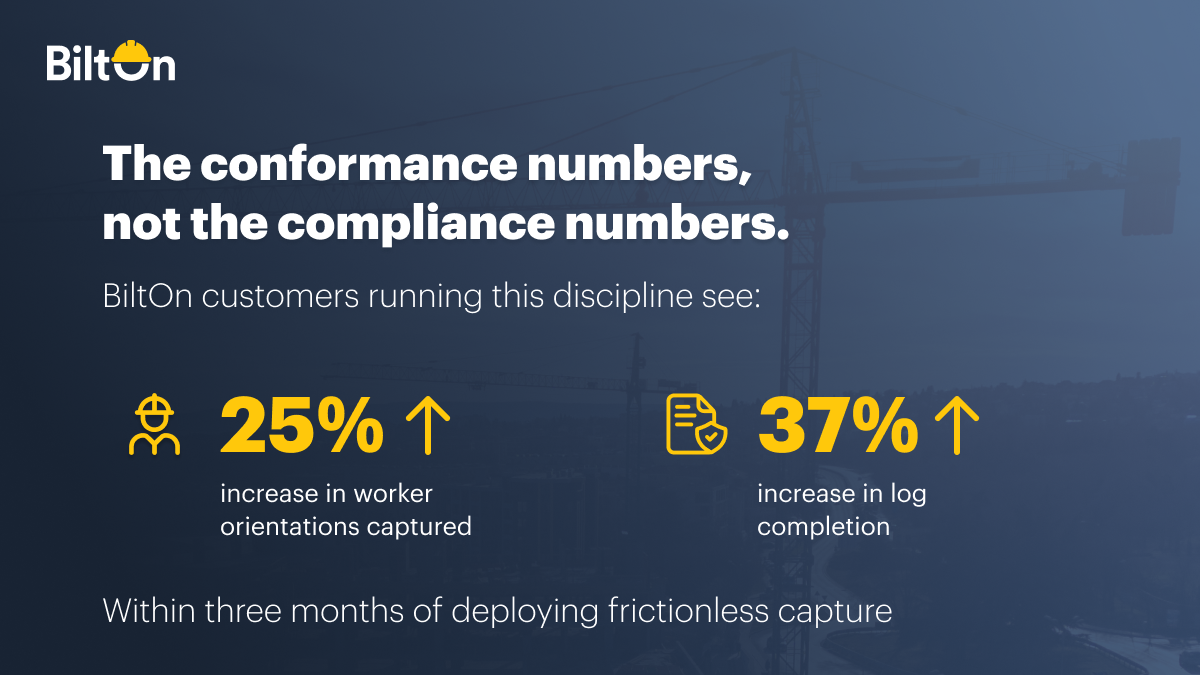
| Log/checklist completion lift | 37% increase within 3 months |
| Worker orientations captured | 25% increase within 3 months |
These outcomes emerge when teams run the operating model intelligent workflows enable, after closing all three failure modes. Buying a platform alone will not move the numbers.
Conclusion
For safety directors, the issue is not whether routines are happening. It is whether those routines create usable, defensible data that helps teams prevent incidents, close corrective actions faster, and show underwriters a safety program they can trust. Three failure modes drive the leakage. The GCs that are evolving their culture to convert field discipline into compressed premiums, lower EMR, and standardize audit trails survive every incident and every claim. That is the real value of intelligent safety workflows.
Want to see what closing these three failure modes looks like across your portfolio? Request a demo.
Frequently Asked Questions
1. What is the difference between safety compliance and safety intelligence?
Safety compliance is the record that a form was completed. Safety Intelligence is the operating layer that turns verified field activity (identity-tied PTPs, observations with documented close-outs, credential checks, incident logs) into predictive, decision-ready data on a portfolio. Compliance answers “did the routine happen on paper?” Safety Intelligence answers “is the next incident already telegraphing itself in the leading indicators, and is the corrective action assigned?”
2. What are intelligent workflows in construction safety?
Intelligent workflows are connected safety routines that produce conformance-grade data automatically. They share one verified worker identity, integrate two-way with Procore and Autodesk Construction Cloud, route observations by severity, and report Time-to-Resolve to project executives at the same cadence as schedule and budget. They are the operating mechanism of Predictive Safety Management.
3. How do intelligent workflows lower EMR and insurance premiums?
EMR is calculated on three years of claims history (excluding the most recent year), so the operating discipline run today shows up at renewal in 18 to 36 months. Intelligent workflows compress claim frequency through faster Time-to-Resolve on observations, reduce claim severity through verified attendance and credentialing, and produce the four-metric underwriting deliverable carriers can price against. BiltOn customers running this discipline see up to a 30% EMR reduction year-over-year and 7% premium and deductible reduction per project.
4. What is conformance-grade data, and how is it different from compliance data?
Conformance-grade data is identity-tied, multilingual where the workforce is multilingual, individually signed (not roster-signed), and includes a quality signal (engagement check, voice-content analysis, or restate-the-control sampling). If the data set cannot show that the right person planned the right work in language they understood, it is compliance data, not conformance data. The carrier and the plaintiff’s counsel can tell the difference even when the dashboard cannot.
5. We already use Procore. Do we need a separate safety platform to fix the three failure modes?
Procore is a strong project and document management system and has expanded into safety with recent AI updates. A crew-ready Safety Intelligence platform complements Procore by feeding verified worker identity, voice-PTP analysis, and audit-grade behavioral records into the same source of truth, rather than duplicating what Procore already does well at the project-management layer. BiltOn integrates two-way with Procore and Autodesk Construction Cloud so the safety record and the project record stay aligned without double-entry.
6. How should we sequence the fix if all three failure modes exist at once?
Sequence on the order they appear in the data. Failure Mode 1 (collection without conformance) is the most upstream and the most operationally tractable; fixing it produces the data set that makes Failure Modes 2 and 3 visible and addressable. The wrong sequence is to attack the dashboard first. If the upstream data is unreliable, no dashboard will produce reliable executive insight.
7. What is the right Time-to-Resolve target on observations?
The benchmark BiltOn customers hit at scale is a 50% reduction in TTR within six months of deploying a closed-loop system. The absolute target depends on project type and severity bands, but the discipline is the same: severity-tiered auto-routing, escalation paths that survive subcontractor turnover, and TTR reported to the project executive at the same cadence as schedule and budget.
8. How does Predictive Safety Management connect to insurance renewals specifically?
Closing the three failure modes produces a four-metric underwriting deliverable: PTP quality, supervisor ratios, observation TTR, and credential verification rate. Carriers can price against those metrics; they cannot price against PDF binders. The shift from binder to behavioral data is what moves a renewal from anecdote to actuarial.
References
- Bilton. (2026). Why Carriers Are Repricing GCs That Can’t Show Behavioral Data.
- Bureau of Labor Statistics. (2024). Census of Fatal Occupational Injuries.
- Bureau of Labor Statistics. (2022). The Construction Industry: Characteristics of the Employed, 2003–20 [Spotlight on Statistics].
- Construction Dive. (2023). Workers Give Construction’s Slow Tech Adoption a Thumbs Down.
- Dodge Construction Network & CPWR. (2023). SmartMarket Report: Safety Management in the Construction Industry.
- FMI Corporation & PlanGrid. (2018). Construction Disconnected: Rethinking the Management of Project Data and Mobile Collaboration.
- Occupational Safety and Health Administration. (n.d.). Leading Indicators in Construction Safety.
- Occupational Safety and Health Administration. (2010). Standard Interpretation: Multi-employer language and accident statistics.
- Zurich North America. (2025, November 14). Zurich Selects Arrowsight to Help Transform Construction Site Safety [Press Release].